


Hydrain® drainage systems for reliable water drainage
High drainage capacity with optimised use of materials
With Hydrain, HUESKER offers geosynthetic drainage systems for consistent water drainage in earthworks and civil engineering. The open 3D monofilament core creates a high void ratio and, in combination with specially matched filter geotextiles or membranes, helps to maintain unobstructed flow paths under load.
The Hydrain Channel and Hydrain Bubble variants are available to meet a range of hydraulic and structural requirements. The two core geometries enable defined or multidirectional water drainage. The core height and functional layers can be selected to suit the load, flow direction, available installation height and required drainage capacity.
Infographic Geosynthetic Drainage as a compact alternative to mineral drainage

High drainage capacity under load
The dimensionally stable 3D monofilament core and the strong bond with the filter fleece limit the fleece’s sinking into the core structure. As a result, the flow space available for water drainage is largely maintained under load.

CO2-reduction potential
The enhanced construction reduces material requirements and product weight. This allows more square metres to be transported per lorry and reduces transport-related CO₂ emissions.

Cost-effective logistics
Low weight and optimised roll formats simplify transport, handling and installation on site.

Suitable for specific projects
Core geometry, core height and functional layers can be selected to meet the project’s hydraulic and structural requirements.
Assessing drainage performance correctly
The performance of a geosynthetic drainage mat cannot be assessed solely on the basis of its thickness or areal mass. The decisive factor is how reliably the core structure drains water under the respective installation conditions and the expected load.
Core structures at a glance
Drainage cores can have different structures. The 3D monofilament, dimpled and geonet structures shown each create the necessary flow space in different ways.

3D monofilament structure
Interconnected plastic monofilaments form an open, three-dimensional drainage core.

Dimpled structure
Dimples formed from a profiled plastic sheet create voids for water drainage.

Geonet structure
Overlapping, intersecting plastic ribs form a mesh-like structure with open spaces.
01 - Creating flow space
Providing voids for water drainage
02 - Utilising flow space
Drain water with as little resistance as possible
03 - Maintain flow space
Ensure a hydraulically effective cross-section under load
04 - Achieve efficient performance
Achieve the required drainage capacity with optimised use of material

Creating flow space
For consistent water drainage, the drainage core requires sufficient free volume. The void ratio indicates the proportion of the core volume available for water conveyance not occupied by the plastic structure. The larger this free proportion, the greater the potential for open flow paths.
Free volume proportion of various drainage structures
The comparison shows the available free volume proportion of three different core geometries at the same model height.
More free space for water drainage
Among the core geometries examined, Hydrain’s 3D monofilament structure has the highest void ratio at 98.3%. This means that a particularly large proportion of the core volume is available for water drainage. The studded and geonet structures achieve a lower free volume fraction.

Utilising flow space
A high void ratio provides the necessary foundation. However, what is crucial for actual water drainage is how the drainage core channels the water through this space. Unobstructed flow paths reduce deflections and bottlenecks, thereby enabling efficient water transport.
Comparison of local flow velocities

a) Dimpled structure

Repeated deflections
The nodules cause repeated changes in the direction of flow.

b) Geonet structure

Restricted flow paths
The modelled ribbed structure restricts the available flow paths and features areas with lower local flow velocity.

c) Hydrain
Unrestricted, continuous flow paths
Hydrain’s open core geometry enables continuous flow paths through the available void space. This promotes uniform flow and efficient water drainage.

Maintaining flow space
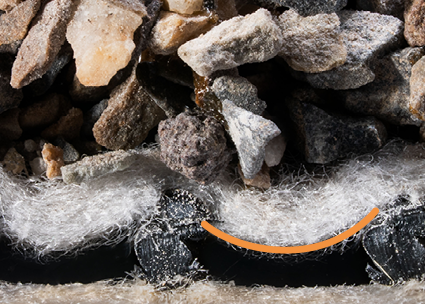
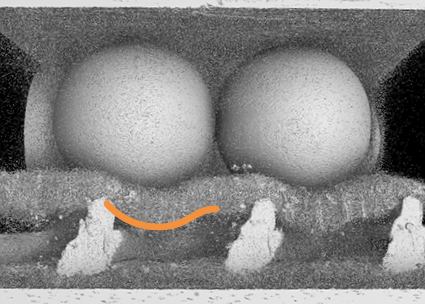
A drainage mat must reliably drain water even under load. To achieve this, it is essential that the void created and the unobstructed flow paths remain intact as far as possible under load. The support provided to the filter fleece by the drainage core plays a key role. The geotextile allows water to enter the core whilst simultaneously limiting the displacement of soil particles. If it sinks into the drainage core between the support points, less flow space is available for water drainage.


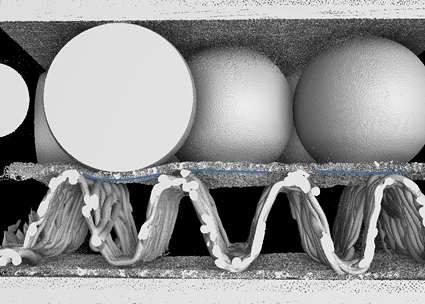
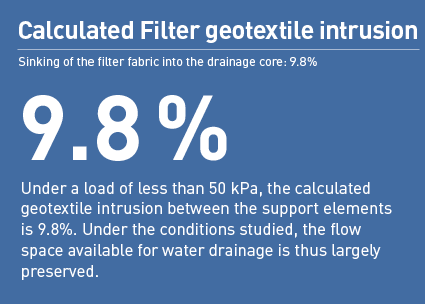
Comparison of three reference products
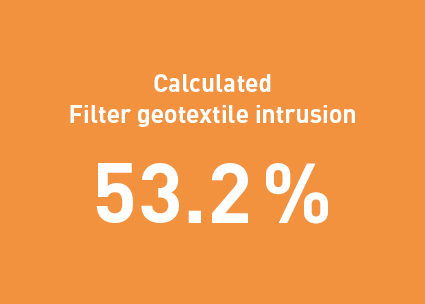
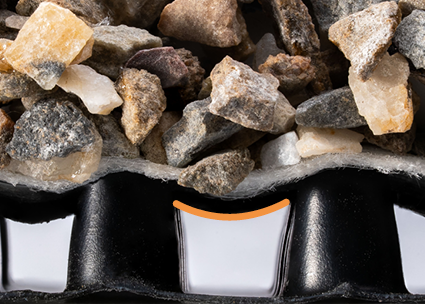
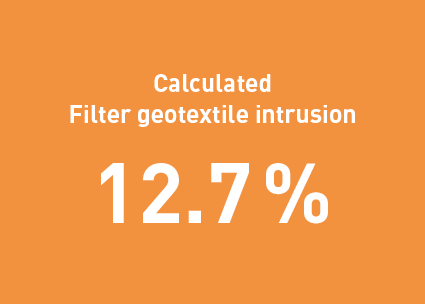
To calculate the fleece intrusion, CT images were analysed in the unloaded state and under a load of 50 kPa. In each case, measurements were taken at five points between the support points of the drainage core. The percentage values indicate the relative subsidence compared with the unloaded state. The results apply exclusively to the products and examined test conditions. Source: HUESKER.
With this reference product, the filter fleece sinks deep into the drainage core. The resulting reduction in flow space limits the potential for water drainage.
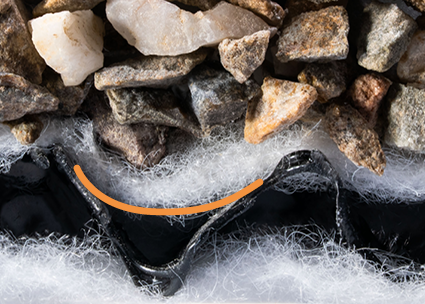
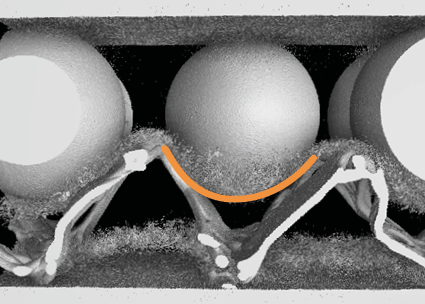
The dimples provide localised support for the filter fleece. Between the support points, it sinks into the drainage core. This reduces both the available flow space and the cross-sectional area for water drainage.
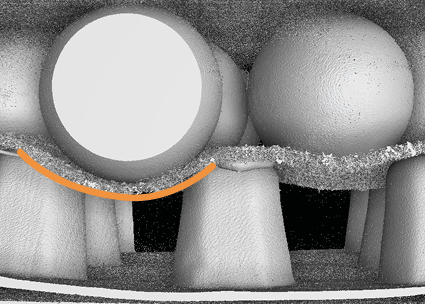
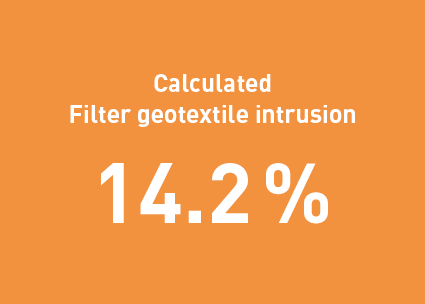
Between the intersecting ribs, the filter fleece protrudes into the meshes. This reduces the local cross-sectional area available for water drainage.
Achieving performance efficiently
When evaluating a drainage mat, it is not only reliable water drainage under load that counts, but also the amount of material required to achieve this. An efficiently designed product core makes it possible to achieve the required water drainage with less material.


Hydrain drainage systems
Developed for reliable water drainage under load

Hydrain Channel
Hydrain Channel is particularly suitable for defined flow directions, high loads and applications with limited installation height. The open 3D monofilament core provides flow space for continuous water drainage and supports the filter fleece under load. Depending on the project, the core is combined with tailored geotextiles and, depending on the product version, with optional membranes. This allows drainage capacity, load-bearing capacity and system configuration to be tailored to the specific requirements.
Hydrain Channel layer structure/strong>
- Tailored top layer for filtration, separation and application-specific protection (optional membrane can be integrated for targeted water control)
- 3D monofilament core for open flow space, continuous water drainage and support of the filter fleece under load
- System-compatible underlay for protection, filtration and application-specific system configuration (optional membrane can be integrated for targeted water management)
Hydrain Bubble
Where large volumes of water are present or flow directions vary, open flow paths and a correspondingly large hydraulic cross-section are required. Hydrain Bubble utilises a profiled 3D monofilament core to drain water in multiple directions. In combination with geotextiles selected specifically for the application and optional membranes, this creates a tailored drainage system to meet these hydraulic requirements.
Layer structure of Hydrain Bubble
- Tailored top layer for filtration, separation and application-specific protection (Optional membrane can be integrated for targeted water control)
- 3D monofilament core for open flow space, continuous water drainage and support of the filter fleece under load
- System-compatible underlay for protection, filtration and application-specific system configuration (Optional membrane can be integrated for targeted water control)

Hydrain Channel and Hydrain Bubble can be tailored to different loads, flow directions and installation conditions. This results in high-performance drainage solutions for a wide range of applications in earthworks and civil engineering.
For the drainage of seepage water and rainwater, as well as for certain product models, landfill gas.

To reduce water and moisture exposure to structural components in contact with the ground.

To reduce waterlogging and water-related instability.

To reduce waterlogging and frost damage in the subgrade.

Further information


